Most strategies don’t fail on ambition.
They fail because the organisation can’t translate intent into consistent execution. The gap between “what we want to achieve” and “what actually happens” is where growth slows, transformation stalls, and confidence leaks out of the system.
In today’s market, that gap is rarely solved by more workshops, more reporting, or more initiatives. It’s solved by building the capability to execute reliably, repeatedly, and at speed.
That’s where technology comes in.
Not as a utility. Not as “the IT stack.” But as the bridge between strategy and delivery.
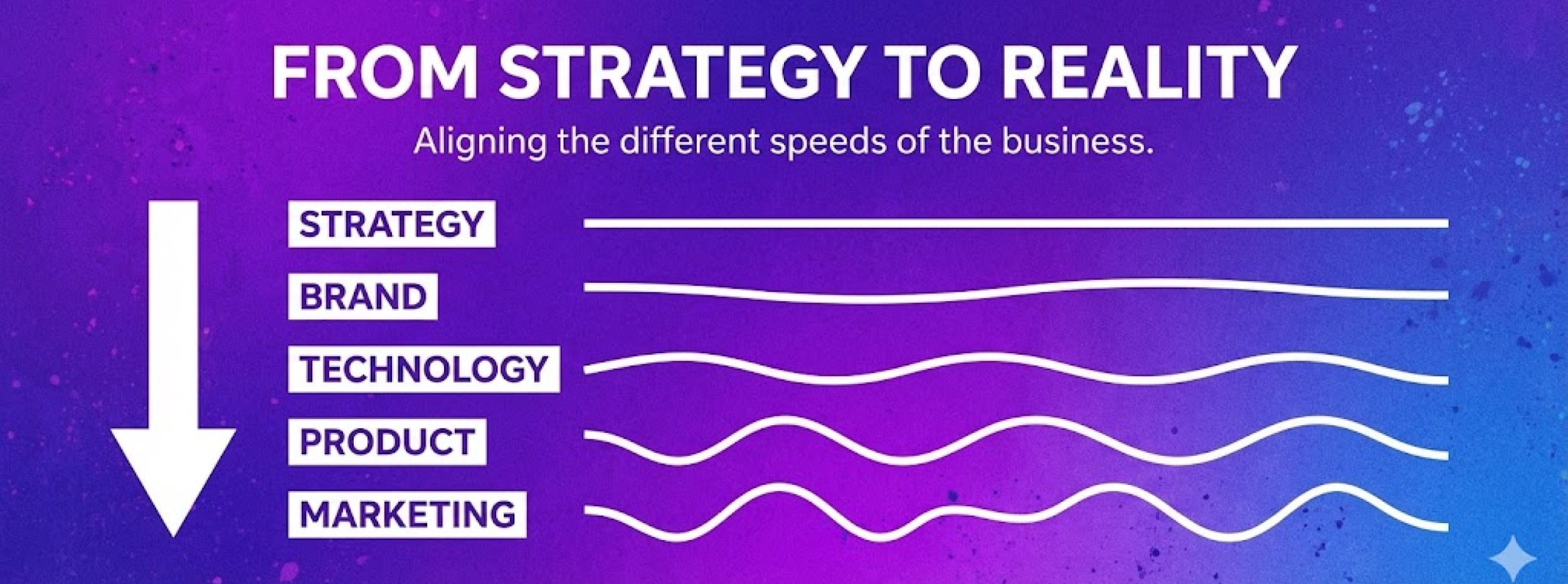
The modern problem: your organisation runs at five different speeds
A useful way to diagnose execution issues is to view your business as five connected layers. Each layer has a natural pace of change. When those paces are aligned, execution feels smooth. When they aren’t, you get friction, rework, and wasted spend.
1) Strategy (10–20 years)
Strategy is direction: where you play, how you win, what you prioritise. In strong companies, this stays relatively stable and only flexes occasionally as the market demands.
When strategy changes too often, teams stop committing. Investment becomes reactive. The organisation loses clarity.
2) Brand (5–10 years)
Brand brings strategy to life. It translates choices into a compelling promise people can understand—customers, employees, partners, and investors.
Brand should evolve, but not swing. If it’s inconsistent or out of date, the market gets confused and growth becomes harder.
3) Technology (1–5 years)
Technology sits in the middle for a reason: it must hold the weight of strategy and brand, while enabling product and marketing to move fast.
It needs to be stable enough for adoption and reliability and flexible enough to adapt to changing customer needs, channels, and data requirements.
That’s why “every company is a tech company” is no longer a slogan. It’s a commercial reality. Your growth is increasingly limited by your ability to deliver digitally.
4) Product (quarterly)
Product - physical, digital, or service must keep up with the market. But it also needs enough time to be sold, adopted, and improved. If product moves too fast without a platform to support it, you get fragile delivery and inconsistent experience.
5) Marketing (weekly, daily, real time)
Marketing is the fastest-moving layer. Channels, creative, targeting, and performance dynamics change constantly. To win, marketing needs the ability to test, learn, and optimise continuously while staying aligned with strategy and brand.
If marketing has speed but lacks systems, you end up with busy activity rather than compounding results.
The hidden failure mode: pace mismatch creates execution debt
Most leadership teams recognise technical debt. Fewer recognise execution debt, the accumulated cost of making commitments without building the systems to deliver them reliably.
Execution debt shows up as familiar symptoms:
-
“We have the strategy, but we can’t ship it.”
-
“Everything takes too long.”
-
“Marketing needs engineering for basic changes.”
-
“The customer journey is fragmented.”
-
“We have data, but we don’t trust it.”
In many cases, the root cause is simple: technology hasn’t been designed as the bridge between layers. So teams compensate with workarounds, manual processes, disconnected tools, and endless coordination. The organisation becomes busy, but progress stays fragile.
What “technology as the bridge” actually means
When technology does its job properly, it produces three outcomes executives care about: speed, consistency, and confidence.
1) Strategy becomes executable
Strategy becomes real when it’s expressed as capabilities:
-
Which customer journeys will we win?
-
What decisions must we make faster?
-
What data do we need to trust?
-
What experiences must improve to drive growth?
-
What must be automated to scale?
This is the difference between “we want to grow” and “we can grow because the system supports it.”
2) Product and marketing can move fast without breaking things
High-performing organisations aren’t just faster, they’re faster safely. They can ship improvements weekly because they’ve designed for change: modular platforms, reusable components, sensible governance, and measurement built in.
This avoids the false trade-offs that slow most businesses down: speed versus quality, performance versus brand, innovation versus reliability.
3) Confidence increases
In considered purchases and high-value decisions, confidence is the control signal that turns intent into action. If experiences are unclear, slow, or inconsistent, customers hesitate. If teams don’t trust the platform, they hesitate. If leadership doesn’t trust the data, investment slows.
Technology is one of the most powerful levers you have to increase confidence at scale.
A quick C-suite diagnostic
Use these questions to pressure-test whether your layers are aligned:
-
Can a customer explain your positioning in one sentence, and is it still true this year?
-
Do sales, marketing, and product tell the same story without rewriting it?
-
Can you improve key customer journeys without a rebuild?
-
Can marketing and product ship changes weekly without engineering firefighting?
-
Do you have a single view of performance leadership trusts?
If the answer is “not consistently” to more than one, the issue is rarely effort.
It’s the bridge.
The takeaway
Strategy should be stable. Brand should be coherent. Product should evolve with the market. Marketing should optimise constantly.
But without technology designed as the execution layer, those parts drift out of sync, and strategy risks staying trapped in a deck.
Treat technology as a utility, and execution debt grows.
Treat technology as the bridge, and growth becomes repeatable.
How 7DOTS helps
At 7DOTS, we help organisations translate commercial ambition into the digital infrastructure that makes delivery real. We take the objective (“the direction”) and design the journeys, platforms, and measurement needed for product and marketing teams to deliver results quickly, consistently, and with confidence.
If your strategy is clear but execution feels slow, fragmented, or hard to measure, the fastest win is often not a new initiative.