How AI is reshaping discovery, research, and decision-making across the funnel
Marketing teams have spent years optimising for a buyer journey that started with a search box. Type a query, scan the results, click a few links, compare options, make a decision. The whole model was built around getting found in search and converting visitors on your website.
That journey is changing. Quickly.
Buyers are shifting from browsing links to asking questions. Discovery has moved from searching to asking, with AI surfacing answers, summaries, and recommendations before anyone clicks a link. Research is getting compressed, with fewer clicks, faster conclusions, and more comparison-driven journeys. Decision-making is increasingly being outsourced to AI, with buyers relying on it to interpret options, shape opinions, and influence shortlists. And we're now seeing the early signs of AI-native commerce, with apps inside platforms like ChatGPT allowing buyers to compare, choose, and purchase without ever leaving the conversation. It's early days, but the infrastructure is being built.
If your brand, content, and digital experience aren't structured for this new reality, you risk becoming invisible at the exact moment your buyers are forming opinions.
This article looks at where we are today, what the data tells us, and where this is heading. The shift isn't theoretical. It's already measurable, and it's accelerating.
The situation today: what has already changed
Discovery has shifted from searching to asking
For years, the top of the funnel was dominated by search engines. Buyers typed queries, scanned blue links, and clicked through to websites. Marketing teams optimised for this, investing heavily in SEO, paid search, and content designed to rank.
AI has changed the mechanics of discovery. Google's AI Overviews now appear on 57% of search results pages, up from just 25% in August 2024 (BrightEdge, 2025). When they appear, organic click-through rates drop by between 34% and 61%, depending on the query type (Seer Interactive, 2025). Around 60% of Google searches now end without a click at all (SparkToro/Datos, 2025).
In parallel, millions of people are now using LLMs like ChatGPT, Claude, Perplexity, and Gemini as their first port of call when researching a topic, product, or service. ChatGPT alone now serves over 800 million weekly users. AI referral traffic to websites grew 527% year-over-year in 2025 (Previsible AI Traffic Report, 2025), and ChatGPT now sends more referral traffic to websites than Reddit and LinkedIn (Digiday/Similarweb, 2025).
The buyer's first interaction with your sector is increasingly a conversation with an AI, where the AI provides the answer, the summary, or the shortlist. If your content and digital presence aren't structured so that AI can find you and understand you, you're missing from that conversation entirely.
Research is getting compressed — and the messy middle is getting messier
The middle of the funnel has always been where buyers get stuck. Google's own research into the "Messy Middle" showed that buyers loop between exploration and evaluation, surrounded by noise, options, and hesitation. It's where confidence stalls and decisions get delayed.
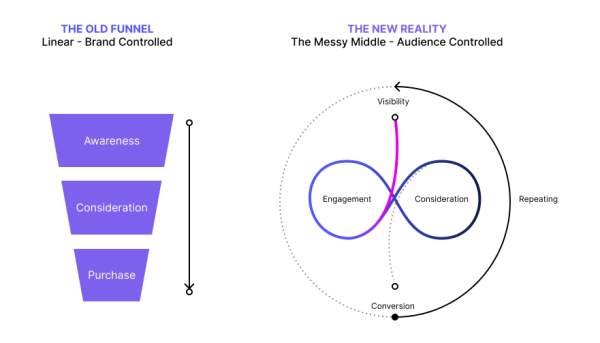
AI is reshaping how buyers navigate this space. Rather than clicking through multiple websites, reading comparison articles, and building their own picture, buyers are increasingly turning to AI to do more of the heavy lifting. LLMs summarise, compare, and present options in a conversational format. The buyer gets a curated view, often with recommendations, without visiting a single website. The number of touchpoints between awareness and consideration is shrinking.
This makes your owned digital experiences even more important when you do get their attention. If a buyer has been guided by AI and arrives at your website, they're already partway through their decision. The experience has to work hard to build confidence and move them out of the Messy Middle. If it's slow, unclear, or asks them to repeat work they've already done, they'll leave.
When buyers do click through from an AI conversation, they tend to be further along in their decision-making. Some studies suggest LLM visitors convert at up to 4.4x the rate of traditional organic search visitors (Semrush via Knotch, 2025), though other research suggests the difference is less pronounced when controlled for site type (Amsive, 2025). Either way, AI-referred visitors are arriving with higher intent. The research has already been done. The question is whether your experience is ready to meet them.
Decision-making is being outsourced
This is the most significant shift. Buyers are increasingly relying on AI to interpret options, shape opinions, and influence their shortlists. Rather than forming a view across multiple sources, they're asking AI to do that work for them.
If your brand isn't surfaced in AI-generated answers and recommendations, you're not being considered. The shortlist is being built before the buyer ever reaches your website.
Gartner predicted in February 2024 that traditional search engine volume would drop 25% by 2026 due to AI chatbots and virtual agents (Gartner, 2024). Looking at the data two years on, that trajectory looks broadly right. The buyer has already moved on. The question is whether marketing strategies have kept pace.
The future: where this is heading
AI agents that act, purchase, and transact
Everything above describes what has already happened at the top and middle of the funnel. The next phase is more disruptive and is already underway: AI that acts on behalf of the buyer.
Insurify: AI as a new distribution channel
In February 2026, Insurify launched the first insurance comparison app inside ChatGPT's app store (Insurify/OpenAI, 2026). US users can now compare car insurance through a conversation, drawing on 196 million quotes and over 70,000 verified reviews. No forms, no multi-step journeys. Just questions and answers.
The market reaction was immediate. US insurance broker stocks fell sharply, with Willis Towers Watson down 13%, Arthur J Gallagher down 10%, and Aon down 9% in a single session (Bloomberg, 2026). Analysts noted that commoditised, retail lines are most exposed, with agency and wholesale broking more resilient due to higher complexity.
This is AI agents in practice, creating entirely new go-to-market channels.
ChatGPT shopping and instant checkout
The commerce infrastructure is building rapidly. In November 2025, OpenAI launched Shopping Research in ChatGPT (OpenAI, 2025), allowing users to describe what they're looking for and receive personalised buyer's guides built from research across the web.
In September 2025, OpenAI introduced Instant Checkout (OpenAI, 2025), enabling users to purchase products directly within ChatGPT. It launched initially with Etsy sellers and is expanding to over a million Shopify merchants, including brands like Glossier and SKIMS. Users can tap 'Buy', confirm details, and complete the purchase without leaving the chat.
OpenAI also open-sourced the Agentic Commerce Protocol, co-developed with Stripe, making it possible for any Stripe merchant to enable AI-driven purchases with minimal integration. This is infrastructure designed to scale.
In February 2026, OpenAI began showing ads to free-tier ChatGPT users in the US (SiliconANGLE, 2026), with plans to evolve ad formats to support Instant Checkout, meaning users could see a promoted product and purchase it in the same conversation.
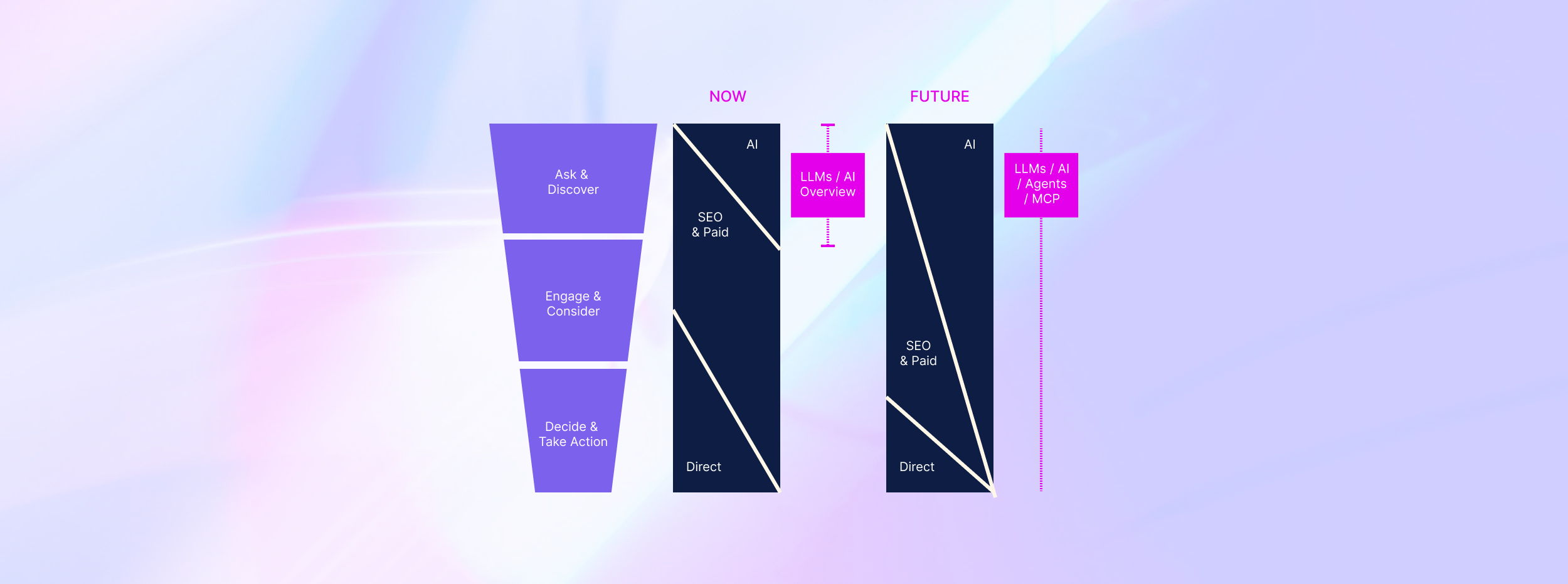
The pattern is clear. Research, comparison, decision, and purchase are all moving inside AI platforms. The traditional funnel, where each stage happened on a different website or platform, is collapsing into a single conversational interface.
The funnel is being reshaped from the top down
If you map this against a traditional marketing funnel, the picture is compelling:
- Discovery: AI Overviews and LLMs are already the first touchpoint for millions of buyers. If AI can't find your content, you're not in the consideration set.
- Research and Evaluation: AI is compressing the Messy Middle, synthesising information and building shortlists on the buyer's behalf. Fewer clicks, faster conclusions. Your owned experiences have to work harder when you do get attention.
- Decision: Apps like Insurify show that AI can handle the decision stage entirely, comparing options and presenting recommendations through conversation.
- Purchase: Instant Checkout and Shopping Ads mean the transaction can now happen inside the AI platform. The buyer never needs to visit your website.
The pattern is clear. Research, comparison, decision, and purchase are all moving inside AI platforms. The traditional funnel, where each stage happened on a different website or platform, is collapsing into a single conversational interface. Today this is focused on simpler purchases: retail, consumer products, straightforward insurance.
But as AI gets better at handling complexity, nuance, and trust-building, considered purchases will follow. The infrastructure being laid now is the foundation for that.
What this means for marketing and digital teams
For marketing and digital teams, this shift has practical implications that need addressing now.
Be structured for AI discovery
Your content needs to be written and structured so that AI can find it, understand it, and reference it. Clear, plain-language explanations of what you do, who you serve, and what makes you different. Question-based content that maps to how buyers actually ask about your sector. Structured data and well-organised site architecture that AI can parse.
Build confidence in the messy middle
When AI does send a buyer to your website, the experience needs to build confidence quickly. They've already done their research. They arrive with intent and expectations. If the journey is slow, unclear, or asks them to repeat work they've already done, they'll leave. Digital experiences need to be designed around the buyer's question, closing the confidence gap and moving them toward a decision.
Think beyond your website
The buyer journey is increasingly happening outside your owned channels. In AI conversations, in app ecosystems, in platforms you don't control. Marketing strategies that rely solely on driving traffic to a website and converting it there are incomplete. You need to think about how your brand shows up wherever the buyer is forming their view, including inside AI platforms.
Prepare for AI-Native commerce
If you sell products or services that could be compared, recommended, or purchased through an AI interface, the infrastructure for that is being built right now. OpenAI's Agentic Commerce Protocol, ChatGPT's Instant Checkout, and Shopping Ads are early signals. Teams that start exploring how AI-enabled services and experiences fit into their customer journey will have a meaningful advantage over those who wait.
The opportunity
How your customers find you, research you, and decide to choose you is changing. The buyers who are already using AI to navigate their purchase journey aren't going back to the old way of doing things.
For marketing and digital teams, the opportunity is to get ahead of this. Structure your content for AI discovery. Build digital experiences that build confidence and close the gap in the Messy Middle. Start exploring how AI-enabled services and experiences can make your brand easier to find, easier to understand, and easier to do business with.
The organisations that move on this now will have a compounding advantage. The ones that wait will find the gap harder to close.
About 7DOTS
At 7DOTS we're helping organisations both be seen through AI, and use it to enhance how they interact with prospects and customers and become more efficient and effective as a business.
Results speak for themselves, we’ve driven $billions in additional revenue for a Fortune 500 global insurance broker, uplifted CCEP’s AI visibility by 247% in 6 months, increased organic traffic for Miller by 40% (despite the trends), and streamlined conversion for The University of Surrey, leading to an uplift in conversion by 76%.
It’s key to take a holistic approach, tackling a channel in silo seldom yields results that drive sustainable growth. If that's something you're exploring, get in touch - we'd love to help.
The data at a glance
Metric |
Source |
|
AI Overviews now appear on 57% of Google search results (up from 25% in Aug 2024) |
BrightEdge, 2025 |
|
Organic CTR drops 34–61% when AI Overviews appear |
Seer Interactive, 2025 |
|
60% of Google searches now end without a click |
SparkToro/Datos, 2025 |
|
Gartner predicted 25% drop in search volume by 2026 |
Gartner, Feb 2024 |
|
AI referral traffic grew 527% year-over-year (Jan–May 2025) |
Previsible AI Traffic Report |
|
ChatGPT sends more referral traffic than Reddit and LinkedIn |
Digiday/Similarweb, 2025 |
|
LLM visitors convert at up to 4.4x organic search visitors |
Semrush via Knotch, 2025 |
|
ChatGPT has 800 million weekly users |
OpenAI, 2026 |
|
US insurance broker stocks fell 9–13% after Insurify ChatGPT app launch |
Bloomberg, Feb 2026 |