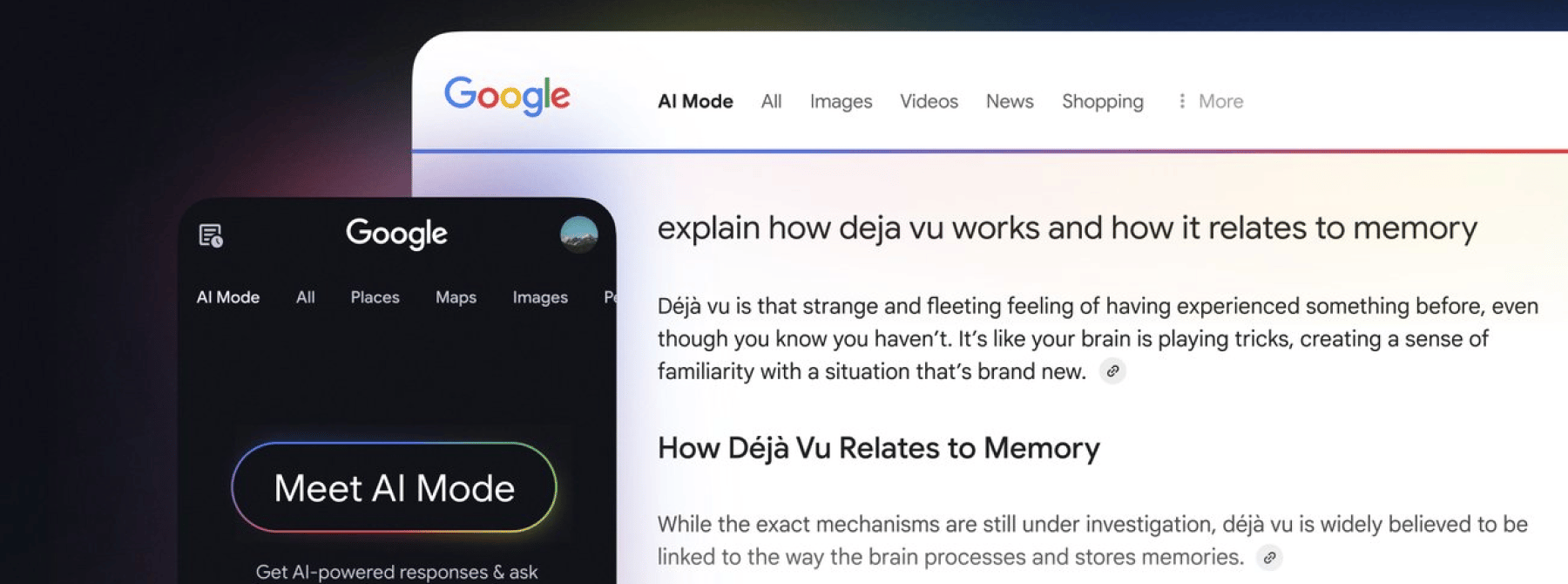
The way people find and choose brands has changed. Customer research has shifted from traditional search engines to AI assistants. Users no longer browse links; they ask questions and receive direct recommendations. Brands aren’t ranked anymore, they are selected.
How it works now
The traditional journey involved multiple small steps: search, scan, compare, click, bounce, refine, and repeat. Every step gave brands a chance to influence.
The AI journey, however, can move from prompt, to answer, to decision; typically, without the need to browse. This reduction in steps removes the evaluation point that brands used to rely on.
In action, AI turns a full search engine results page (SERP) into a single recommendation, which creates a level of scarcity search has never had. The model chooses one or two brands it trusts most and discards the rest. Without a “page two” safety net, visibility becomes fully binary.
For considered-purchase categories, the research journey is therefore becoming reliant on the model, not a marketer.
Prompts that bypass your website
Everyday prompts have advanced to skip websites entirely. These include:
- Category queries: ‘What’s the best income protection insurance for freelancers?’
- Local services: ‘Who is the most reliable plumber near me?’
- Brand comparisons: ‘Is Brand A or Brand B better for problem X?’
In these scenarios, AI decisions rely on collective opinion, not your owned website content.
The psychological shift
Users now treat AI answers as a “pre-filtered truth.” A single answer feels objective because it blends multiple sources behind the scenes. This absence of choice increases trust, with people assuming the AI model has already done the comparison work for them.
High-stake decisions then become riskier because if AI excludes you once, then users will assume you are not a credible option.
How visibility is determined
With the position and influence of AI in mind, the effect of external signals on its recommendations also becomes key:
- Reviews: A highly ranked source of data, providing direct proof of service quality and reliability.
- Forums (Reddit, Quora): Unfiltered user opinions and real-world opinions.
- Curated Lists & Media: Mentions on publisher, comparison and expert sites.
- Profiles and directories: LinkedIn, Crunchbase, and industry directories help define your category, positioning, and credibility.
- Citations: Mentions across the web that train the LLM on who you are.
Footprint density
Over time, AI rewards brands that appear consistently across multiple platforms with aligned messaging, as clarity is crucial to AI’s understanding of a company.
Essentially: Density = frequency + consistency + distribution.
Ahrefs' analysis of 75,000 brands found that a significant number of web mentions were the leading factor in AI systems forming a clear perception of a brand. This constitutes a particular footprint density that allows LLMs to then categorise and confidently recommend it.
The snowball effect
Once AI starts recommending you, it compounds. Mentions lead to more mentions which create a stronger understanding of your brand and creates a generative cycle where the model finds more evidence to justify your inclusion. One strong mention in an AI answer can spark new Reddit threads, fresh reviews, or third‑party citations.
The feedback loop: AI mentions > user discussions > more citations > stronger training data.
Comparatively, success in an SEO context is linear and content driven. You publish content, earn links, improve rankings, and gradually increase traffic. It is predictable and incremental. While SEO rewards volume, AI rewards corroboration. Ten blog posts don’t matter if the wider web isn’t talking about you. AI visibility grows when multiple independent sources reinforce the same story.
An important caveat
However, AI answers can vary significantly between identical prompts, making visibility unpredictable. You cannot optimise for a stable ranking the way you could with Google, you’re competing for inclusion in a rotating list that changes with every query.
Brands with weak signals fall out of this rotation because the model has no stable reason to resurface them.
Adapting your owned content strategy
While external visibility is nevertheless fundamental, your website still acts as a critical baseline, provided it is structured for machine recognition/
AI systems construct entity graphs over scanning for keyword lists. If your content does not clearly define your product, audience, or USPs, the AI model can’t place you with any confidence, and you will be excluded from answers.
Further, any messaging, pricing, positioning, or naming variations between the site and external platforms will erode model trust. To maximise recognition, brands must present information cleanly through structured data, schema markup and concise FAQs.
The danger of generic AI content
For considered-purchase brands where specialised expertise is the core offering, churning out generic, AI-generated blog posts, is not favoured by AI models.
LLMs deprioritise derivative content; publishing articles that replicate existing web content signals that your brand is following rather than leading. Additionally, high-volume automated publishing often introduces subtle inconsistencies in tone or terminology, confusing models and diluting trust signals.
Navigating content inflation
In the current era of content inflation, content volume is exploding yet users aren’t reading more, they’re reading less, with AI often doing the reading for them. The Reuters Institute’s 2024 Digital News Report shows that younger audiences now avoid long‑form articles and prefer condensed formats or AI‑generated summaries instead.
Meanwhile, Microsoft’s Work Trend Index highlights that people feel overwhelmed by information and are turning to AI tools to summarise and interpret content for them.
With AI absorbing the reading load, the value of any individual blog post drops significantly. AI systems react to this flood of noise by becoming far more selective, favouring deep authority signals over publishing volume.
What brands need to do now
To thrive in this evolved landscape, brands must ground their digital presence in four essential pillars:
- Authority: Build proof and a repertoire across the ecosystem.
- Clarity: Define your brand in a way that AI can understand.
- Structured data: Make your information machine-readable.
- Reviews: The most powerful trust signal you can influence.
Your website is still a critical asset, but it’s no longer the centre of your digital universe. AI visibility depends on your complete digital footprint, and brands that optimise for this new landscape will be the ones trusted by AI.
7DOTS helps brand move faster by mapping your visibility footprint and identifying the gaps that are holding you back. We build the systems, content, and alignment needed to strengthen your visibility across the entire ecosystem.
If you want to become the brand AI recommends, not just the one with the best website, we can help you get there.
Speak to a member of our team to find out more.